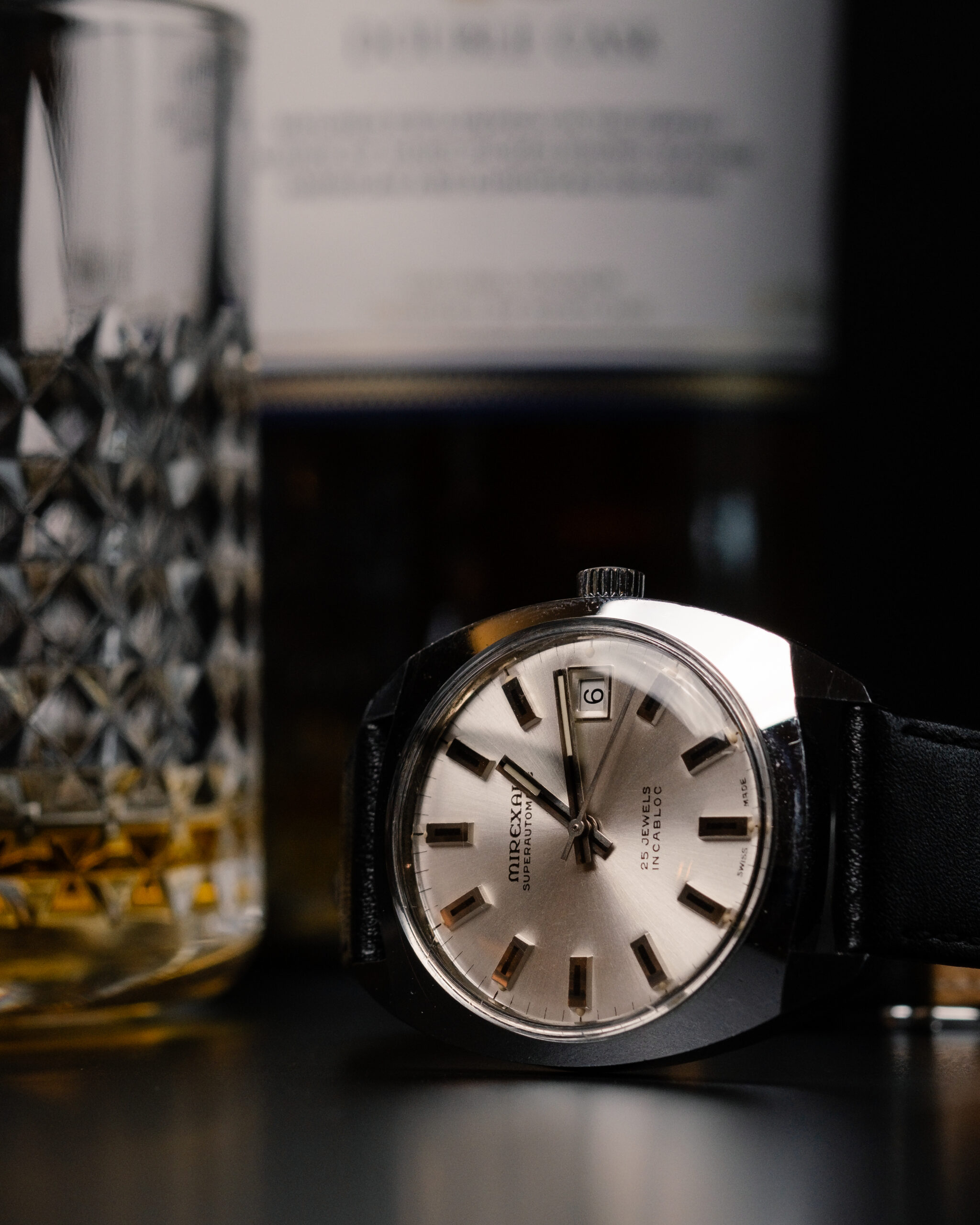
Mirexal was the house watch brand for Migros, the Swiss supermarket chain, and in the 1970s they didn’t cut corners on it. The movements reportedly came from real Swiss manufacturers, Rotary and Mondaine among them, not some fashion-watch assembly line filled with plastic. Mine is the dress version: a plain silver starburst dial that catches the light differently depending on the angle, an ETA 2783 automatic underneath, sized right in that 35 to 37mm sweet spot vintage dress watches tend to land in. Nothing about it announces itself. That’s most of the appeal.
I found it on 2dehands.be, of all places, scrolling during a shift at a job I don’t work anymore. Someone local was selling it for 25 euros. It ran, but it needed maintenance, the kind of listing most people scroll straight past without a second thought. I didn’t. A genuine Swiss movement for 25 euros, even one that needed work, felt like arithmetic worth acting on. Whether I ended up paying someone to service it or figuring it out myself, the math still favored me either way. Twenty-five euros buys you a lot of room to experiment.
It disappears the way a good dress watch should. It slides under a cuff without a fight, and the proportions mean it never feels like it’s asking to be looked at. Most days that’s exactly what I want from it: something that tells time and gets out of the way.
It also doesn’t feel precious, which matters more than it sounds like it should. I’ve worn it wrestling a toddler into a car seat, hauling cycling gear out of the garage, the kind of moments where a more expensive watch earns a second thought before you commit to them. With the Mirexal I don’t think about it at all. It just does the job, catches the light on that starburst dial, and moves on with the day.
There’s a second layer to it too, if you want one. Most people see a plain silver dial and move on without a glance. The few who actually ask get the whole story: Migros, Rotary or Mondaine under the hood, 25 euros off Twitter. Quiet most days. A conversation the moment I want it to be one.
Genuinely, not much. The lume is dead, completely gone, so any glance in the dark comes up empty. That’s the entire complaint. Weighed against everything else the watch gets right, and against what I paid for it, I’m not exactly in a position to hold a grudge over a decades-old lume compound giving up on me. If it bothered me more, it would say something about the watch. It doesn’t, and that says something too.
It’s the most-worn watch I own that cost less than a sleeve of golf balls, and that’s not nothing. I’d buy it again without hesitating, dead lume included. Between the story behind it and what it actually does on my wrist every day, 25 euros might be the best watch money I’ve ever spent.